The Public Reference for
Local Cloud Development
Understand the difference between local cloud emulation and local cloud development
The two Ideas behind it
Most tools blur these two together — which is exactly how a carefully maintained emulator ends up looking the same as a weekend project.
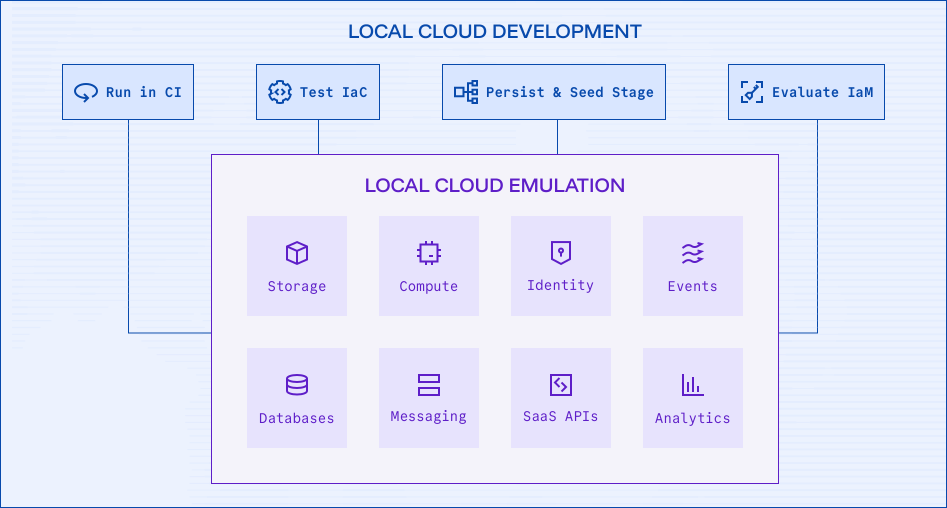
Local cloud emulation
A faithful local stand-in for cloud and SaaS services — object storage, queues, databases, payment APIs. Your code creates buckets, sends messages and calls endpoints exactly as it would in production, except nothing leaves your machine and nothing costs money.
Local cloud development
What you build on that base: running your test suite in CI against emulated infrastructure, validating Terraform or Pulumi before you deploy, seeding and persisting state across runs, exercising IAM. Emulation makes it possible — development is the workflow that turns it into faster, more reliable delivery.
Find the right local cloud
emulator
The public reference for local cloud development, find emulators
across cloud and SaaS providers.
LocalStack
A fully functional local AWS cloud stack. Develop and test your cloud and serverless apps offline.
Moto
A library that mocks AWS services for Python tests, with a standalone server mode for other languages.
WireMock
A flexible API mocking server. Stub, record, and replay HTTP APIs with fault injection built in.
The practices that separate a real emulator from a wrapper
Anyone can stub an API. These are a few of the practices that make emulation trustworthy enough to build on — and that our benchmark checks for.
Read our BenchmarkParity testing
Responses are checked against the real cloud API — status codes, edge cases, errors — so it behaves like the service, not just the happy path.
Snapshot tests
Known-good responses are recorded and re-checked, so a regression is caught the moment the emulator or upstream service drifts.
Persistence
State survives restarts and reseeds the same way every run, so local stays reproducible.
Dockerized distribution
Shipped as a container, so the whole team and CI share one reproducible environment.
IaC Parity
Runs the same Terraform, CloudFormation, or Pulumi you deploy with, so local matches production.
Active maintenance
Kept current with upstream cloud changes — the signal an emulator won't quietly rot as APIs evolve.
Where to start
A few hand-picked places to begin — whether you’re learning the
space or judging a specific tool.
Architecture Reference
CI, IaC, persistence — how it fits together.
Browse architecturesBest Practices
What trustworthy emulation requires.
Read the guidesGlossary
The shared vocabulary of the space.
Open the glossaryContribution Guide
Have a tool you can contribute? Read up on how you can do it.
How to contributeFrequently Asked Questions
Common questions about emulation, the registry, and how the benchmark works.
What is local cloud emulation?
Local cloud emulation means running functional replicas of cloud services — databases, queues, storage, APIs — directly on your machine or in CI, instead of connecting to a live cloud account. Your application talks to the emulator exactly as it would to the real service, so you can develop and test without deploying, without cloud costs, and without network dependency.
Why use a local cloud emulator instead of a real cloud account?
Emulators give you faster feedback loops, zero cloud spend during development, and tests that run offline and in parallel without shared-environment conflicts. A deploy-and-test cycle against a real cloud takes minutes; against a local emulator it takes seconds. They also remove the risk of tests touching production data or leaking credentials.
What's the difference between an emulator and a mock?
A mock returns canned responses you define per test; an emulator implements the service's actual behavior — state, error semantics, and API contracts. Mocks verify that your code calls an API; emulators verify that your code works against how the service actually behaves. That's why the registry distinguishes real emulators from thin API wrappers, and why our benchmark checks behavioral fidelity, not just endpoint coverage.
What is Local Cloud Community?
Local Cloud Community is the public reference for local cloud development: a registry of local cloud emulation tools across AWS, Azure, GCP, databases, messaging, storage, compute, payments, and more. Each listing includes license, GitHub activity, distribution format, and how the tool performs against our benchmark practices, so you can compare tools on evidence rather than marketing.
Is the registry vendor-neutral?
The registry lists tools from all vendors and open-source projects under the same criteria and the same benchmark. It is maintained by LocalStack's DevRel team, and listing, ranking, and benchmark results are based on public, reproducible data — the methodology is documented openly so anyone can verify or challenge a result.
How do I choose the right local cloud emulator?
Start by filtering the registry to your cloud provider or service category, then compare candidates on license, maintenance activity (last update, GitHub stars), distribution format, and benchmark results. For a guided path, the "Where to start" section curates entry points whether you're learning the space or evaluating a specific tool.